Set out on a path of outstanding durability and versatility with our Incoloy Forgings, thoughtfully custom-built to excel in the most challenging industrial settings. Crafted with painstaking attention to detail and reinforced with remarkable strength, our Incoloy stainless steel forgings set a new standard for reliability in critical applications. Boasting unrivaled corrosion resistance and lasting toughness, our forgings surpass conventional alternatives, delivering dependable performance where others fall short. From high-temperature uses in aerospace engineering to corrosive chemical processing within industrial plants, our extensive selection of Incoloy Forgings guarantees lasting resilience and reliable functionality. Dedicated to exceeding customer expectations, we offer tailored solutions, competitive pricing, and rapid delivery, ensuring smooth integration into your projects with precision and efficiency. Rely on our premium-grade forgings, backed by a steadfast commitment to quality and performance, to raise your endeavors to unprecedented heights of success.
| Specifications | ASTM B564, ASME SB564 |
|---|---|
| Standard | DIN, ASTM, BS and all International Standards |
| Flat bar blocks | up to 27″ width and 15,000 lbs |
| Cylinders and sleeves | up to 50″ maximum O.D. and 65″ maximum length |
| Discs and hubs | up to 50″ diameter and 20,000 lbs |
| Rolled, hand forged or mandrel forged rings | up to 84″ maximum O.D. and 40″ maximum length |
| Rounds, shafts and step shafts | up to 144″ maximum length and 20,000 lbs |
| Forging Types | Impression Die Forging, Open Die Forging, Seamless Rolled Forging, Hot Forging, Cold Forging, Open die hammer forging, Impression die drop forging, Closed Die Forging, Press Forging, Upset Forging, Compression Forging, Swaging, Rotary Forging, Roll forging. |
| Grade | Ni | Cr | Fe | Mo | Cu | Ti | Al | Mn | Si | Nb | C | S |
| Incoloy Forging | 42.0-46.0 | 19.5-22.5 | Min 22 | 2.5-3.5 | 1.5-3.0 | 1.9-2.4 | 0.1-0.5 | Max 1.0 | Max 0.5 | Max 0.5 | Max 0.03 | Max 0.03 |
At Santossteel, we take pride in being the largest supplier and manufacturer in the Brazil, delivering advanced solutions for all your piping requirements. With cutting-edge production facilities strategically situated in the Brazil, we maintain an extensive inventory of more than 25,000 tons of premium-quality materials kept ready in stock.
Reach out to us for a fast quote tailored to your requirement.
We supply these Incoloy Forging in accordance with DIN, ISO, JIS or ANSI Standard.
Incoloy Forging uses are as varied as the sectors they support, led chiefly by the aerospace, railway, construction and automotive sectors along with petrochemical, nuclear, medical, Oil & Gas, Chemical, Pharmaceutical, Food & Beverage, Nuclear, Thermal Power plants, Paper and Pulp, marine and mining, etc.
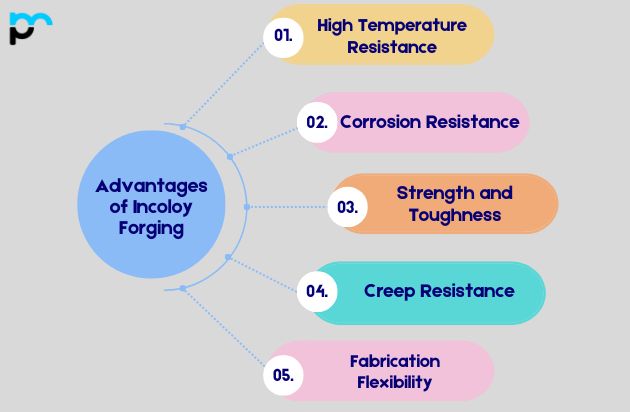
Corrosion Resistance: Evaluate the setting where the forgings will operate. Take into account any corrosive substances present, such as acids, alkalis, saltwater, or other chemicals. Pick an Incoloy alloy that offers suitable corrosion resistance for those particular conditions.
Temperature Resistance: Identify the range of operating temperatures your application will experience. Various Incoloy alloys provide different degrees of heat resistance. Opt for a forging material capable of enduring the temperatures met during service without weakening its mechanical properties.
Mechanical Properties: Take into account the mechanical demands of your application, such as tensile strength, yield strength, ductility, and toughness. Pick an Incoloy alloy and forging process able to deliver the required mechanical properties to handle the intended loads and stresses.
Fabrication Requirements: Assess the intended shape, size, and complexity of the forgings your application requires. Select a forging technique (such as open die forging or closed die forging) and Incoloy grade that can support the necessary fabrication processes while preserving dimensional accuracy and structural integrity.
Yes, Incoloy forgings are recyclable once their service life ends. The alloy can be melted and repurposed to produce new forgings or alternative products, supporting sustainability and resource conservation initiatives across many industries. Recycling serves to cut down on waste and lessens the demand for virgin materials during manufacturing.
Incoloy forgings are typically discouraged for hygienic and sanitary uses because of the possible leaching of nickel and other alloying elements. Stainless steel is frequently the material of choice thanks to its better corrosion resistance and suitability for the demanding cleanliness standards found in sectors like food processing, pharmaceuticals, and healthcare.
Yes, Incoloy forgings may be vulnerable to galvanic corrosion when placed in contact with unlike metals within an electrolyte. To reduce the risk of galvanic corrosion in applications involving several metals, careful attention to material compatibility and suitable isolation methods is required.
Yes, Incoloy forgings are suitable for underground use, as long as they receive adequate corrosion protection. Incoloy’s corrosion resistance makes it a good fit for underground piping networks, chemical storage tanks, and other infrastructure that may face contact with soil and moisture, when the right corrosion protection measures are implemented.
